It’s All in the Core

Understanding the core helps us move with strength, stability, and energy. There is something about a well-defined set of abs that makes the body look fit and strong. But flat abs, or even a six-pack, do not necessarily translate to strength. What we really need is a strong core. Although it shares the same general location as the abs, the core is not interchangeable with the abdominals. Abs Are Not the Same as the Core The abdominal muscles enable the trunk to bend forward, as when we do sit-ups or curl-ups, bend side to side, and twist clockwise and counterclockwise. We use these movements several times in daily life, and the stronger the abdominals, the more easily we move. The only muscle of the abdominal group that makes up the core is situated deep inside: the transversus abdominis. Deep Core Stabilization The transversus abdominis is not a muscle that creates big movements. It is a muscle we need to learn to access for stability and control. The core is also made up of deep lower back muscles, the pelvic floor, and the diaphragm. Together, these muscles form a supportive corset around the torso and help protect the body. If you have ever injured your back, suffered back pain or pain around the hips, or hurt your shoulders, hips, or knees, working on your core may help you feel like you have changed your whole body. Why Core Strength Matters Most exercises target big muscle groups: the abdominals, the muscles around the hips and thighs, and the shoulders. These are also the big movers. The core is not a big mover. It supports, stabilizes, and controls big movements. Without core stabilization, we are likely to overburden the big movers, which may lead to pains and injuries. Pilates Builds Core Strength Pilates is a total body workout that develops core strength. It works the big muscles, small muscles, and deep muscles using core strength as the basis of each exercise. Every exercise in Pilates is, in fact, a core exercise. Pilates first teaches us to turn on the core through breathing. We learn to lead with the breath, activate the core, and maintain that activation throughout movement. In Pilates, the core is also known as the powerhouse because it is the body’s source of strength and dynamic energy. The whole body grows stronger and less prone to injuries when we learn to engage the core and draw strength from it in cooperation with the big movers. Taking Core Strength into Daily Life With Pilates training, using the core becomes as natural as breathing. The goal is to recruit core strength beyond doing Pilates and beyond exercising, into daily living. Turn on your core when driving, cooking, working on the computer, cleaning the house, and walking between places. Turn on your core, period. Get strong from the inside out. Work on your core with All Core Pilates at Upper Ground Floor, Commerce Mall, Alabang Town Center. Book Now.
Pilates in Full – Beyond Reformers

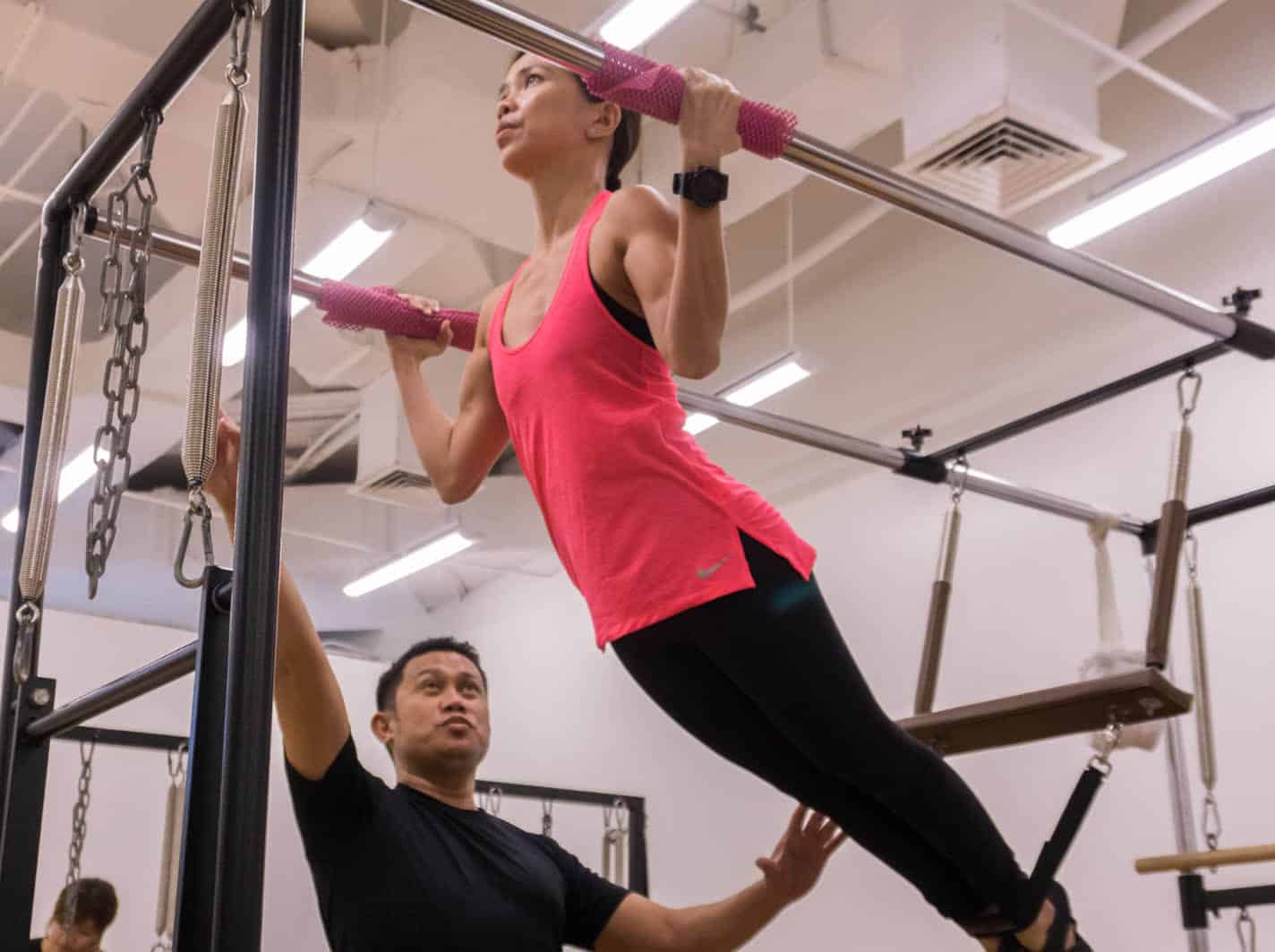
Every Pilates class is an adventure. The variety of props, machines, and equipment this exercise method can feature makes each session exciting, challenging, and well spent. Reformers are famous in Pilates for good reason. With proper form and good alignment, reformer exercises feel stress-free and are safe to perform while highly effective in strength and stability training. The exercises are dynamic and become progressively more challenging as the body grows stronger. As fun as reformers are, Pilates exercises using other apparatus are sometimes underrated, yet they can be just as exciting and effective. Mat Pilates Mat Pilates forms the foundation of all Pilates exercises done on the reformer and other equipment. If spring tension moves the carriage on the reformer, nothing but the body provides the tension, push, and pull on the mat. This is why mat Pilates can feel more difficult: you have to carry your own weight and stay in control of your body. Props such as the barrel, blocks, sponge ball, Flex Band, Fitness Circle resistance ring, toning balls, and hand weights bring variety to the exercises. They help target specific muscle groups and can increase or decrease the intensity of an exercise. The Cadillac The original Cadillac was designed by Joseph Pilates. In its earliest version, it was simply a hospital bed with makeshift springs attached to it. Joseph used these beds to rehabilitate injured soldiers during World War I, and he continued to improve his ideas until the Cadillac came into being. Although it traces its origins to injury rehabilitation, the Cadillac is also used to challenge the body by isolating muscles. Its independent springs require the left and right sides of the body to work equally. The Trapeze and Fuzzies are attachments across the top frame of the Cadillac that help with everything from simple stretches to more intense exercises. Hanging Abdominal Curls, for example, are less about hanging upside down and more about having the core strength to curl without being grounded on the mat. The Stability Chair The Split-Pedal Stability Chair is a compact apparatus that trains balance and stability on a smaller base of support. You can exercise sitting on the Chair, or work lying down or standing at the front, back, or sides of it. The Chair can isolate the lower and upper body, and the split pedals allow you to isolate the left and right sides of the body. It can support rehabilitation exercises, prenatal and postnatal exercises, strength training, and athletic conditioning. Get the full Pilates experience at All Core Pilates at the Upper Ground Floor, Alabang Town Center. Call or text 0917-187-2207 for more information. Book your training.